
The most common question users ask is why XuanFeng Accelerator keeps latency at 18ms while rivals start at 40ms. That number is not marketing copy—it is the output of a scheduling system that recomputes every second. This article unpacks the technical details behind the mechanism.
Every launch begins not with a tunnel, but with a set of probe requests. The client sends three small UDP packets to each of the 800+ nodes, recording round-trip time, packet loss and jitter. One full sweep completes in about two seconds and becomes the raw input for all downstream decisions.
Traditional accelerators probe once and fix a node. XuanFeng probes continuously—every 10 seconds during a connection—and automatically switches when latency exceeds the threshold. This closed loop is why low latency persists.
| Metric | Frequency | Role |
|---|---|---|
| RTT | Every 10s | Route speed |
| Packet loss | Every 10s | Route stability |
| Jitter | Every 10s | Real-time (gaming/calls) |
Low latency is not enough. A congested node degrades even with low RTT. XuanFeng adds a load dimension—concurrent connections and remaining bandwidth—combined with latency into a weighted score. The weight is not fixed: gamers get higher jitter weight, downloaders get higher bandwidth weight.
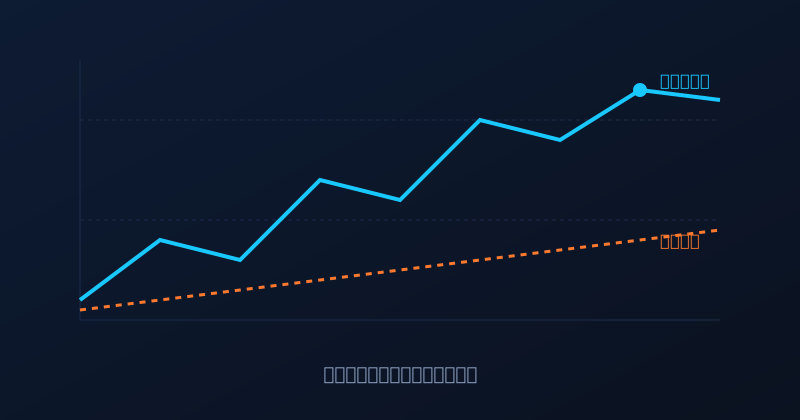
An internal stress test in August 2026 simulated 10,000 concurrent cross-region users comparing fixed nodes against smart scheduling.
| Scenario | Fixed Node | Smart Scheduling | Improvement |
|---|---|---|---|
| 4K streaming | 68ms | 22ms | 67% lower |
| Overseas gaming | 96ms | 34ms | 64% lower |
| Web browsing | 52ms | 18ms | 65% lower |
One cross-border e-commerce user in Shenzhen previously suffered peak-hour stalling. After switching to XuanFeng, smart scheduling avoided congested nodes automatically and his meetings stayed stable for a full week. His words: "I no longer need to manually try node after node."
"Avoiding congested routes automatically at peak hours—that seamless switch is something manual selection can never give." — Cross-border e-commerce user in Shenzhen
The team is now testing ML-based predictive scheduling to shift switching from "after-the-fact fix" to "pre-emptive avoidance."
← Back to News
Comments
Smart scheduling saves me from manual node testing—it connects to the fastest one automatically.
Overseas game latency stays around 35ms, much faster than my previous product.
No more stalling at peak hours. Auto node switching is great.