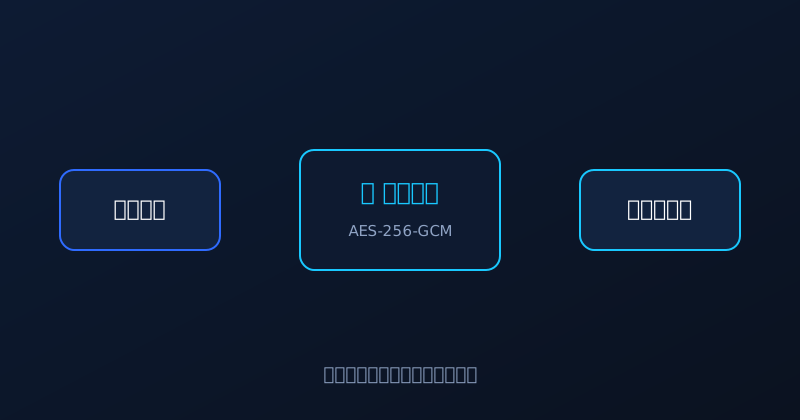
Many people think of an accelerator as "fast" first—but "fast" only matters if it is "safe". An unencrypted tunnel exposes browsing records and account data to every hop. XuanFeng has made encryption the default since day one. This article explains how it keeps data safe without sacrificing speed.
An accelerator builds a tunnel between the user and the target server. Every segment—public WiFi, carrier backbones, third-party datacenters—can be tapped. Encryption turns the data into unreadable ciphertext.
XuanFeng uses a dual-protocol scheme: WireGuard by default, with a fallback to AES-256-GCM on some networks. WireGuard is a lean, high-throughput protocol merged into the Linux kernel and battle-tested in production.
| Protocol | Algorithm | Characteristic |
|---|---|---|
| WireGuard | ChaCha20-Poly1305 | Fast, low overhead |
| Fallback | AES-256-GCM | Compatible, proven |

Encryption adds compute overhead, but modern CPUs have AES instruction sets—overhead is microseconds and negligible in practice. In fact, unencrypted traffic often faces stronger QoS throttling. Internal tests show throughput differences within 5%.
| Test | No Encryption | Encrypted | Delta |
|---|---|---|---|
| Download throughput | 412 Mbps | 395 Mbps | -4.1% |
| Connection setup | 1.1s | 1.3s | +0.2s |
Encryption protects the "transit", not everything. Complete privacy also needs a no-logs policy—if the server keeps access logs, encryption alone is not enough. XuanFeng keeps connection data only on the local device. Encryption plus no-logs forms the full privacy line.
"I'm not technical, but knowing it's bank-grade encryption puts me at ease—and speed doesn't feel slower." — A privacy-conscious user
The team is evaluating post-quantum algorithms to prepare for future computing power. Security is a long run without a finish line.
← Back to News
Comments
WireGuard is fast—connecting feels seamless and I feel secure.
Encryption matters on public WiFi. This article helped me understand why.
The speed difference between encrypted and not is negligible—convincing data.